
Understanding Retirement · 6 min read
Retirement Savings and Retirement Income Aren't the Same Thing
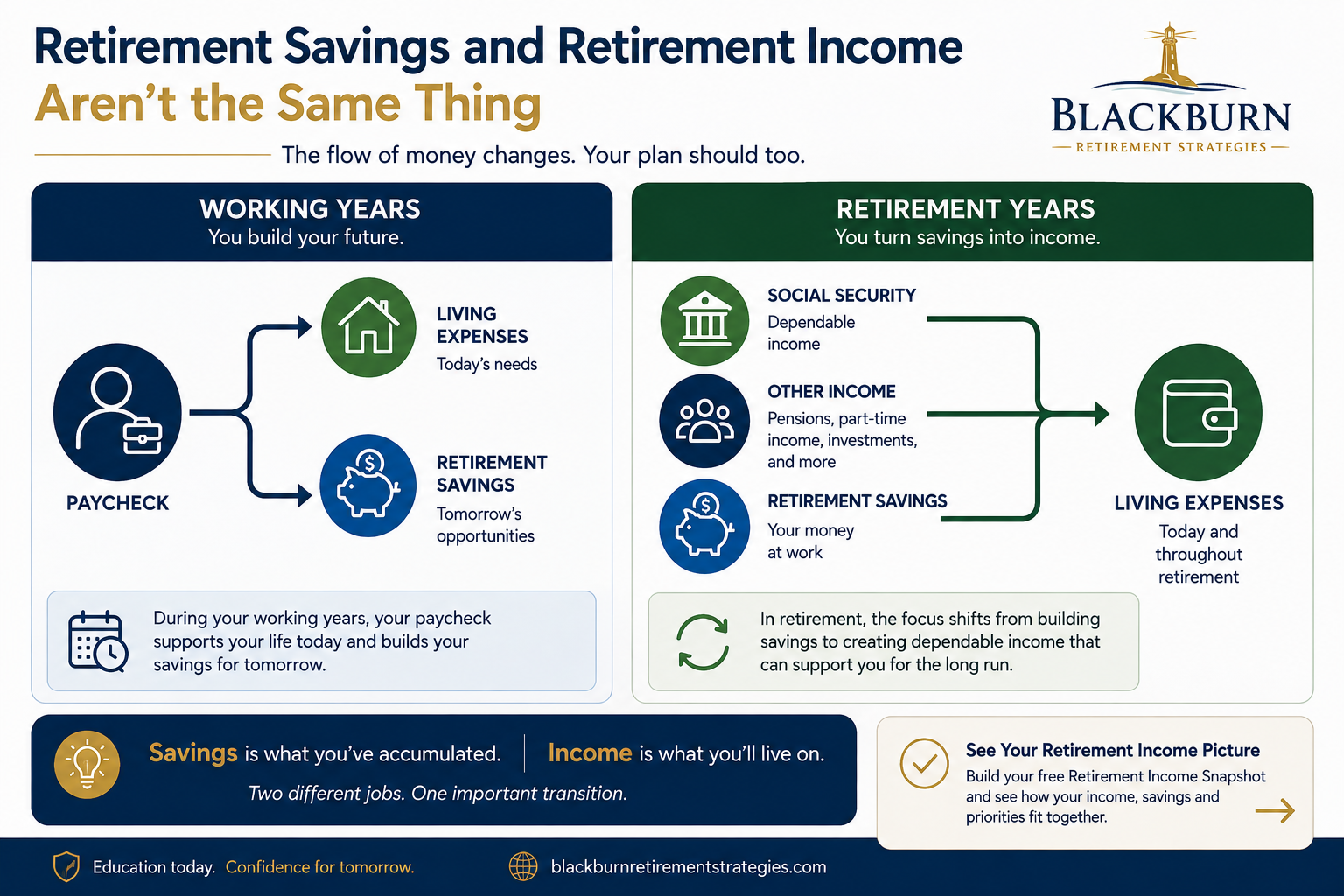
Building retirement savings gets you to retirement. Turning those savings into dependable income is what helps you live through it.
For most of your working life, the goal is fairly straightforward: save and accumulate as much as you reasonably can for retirement.
Then retirement changes the assignment.
Instead of putting money into your accounts, you begin asking those accounts to help pay you. That shift—from accumulating savings to creating income—is one of the most important transitions in retirement planning.
Saving for retirement has one job. Retirement income has another.
During your working years, you generally have two things happening at the same time:
- Your paycheck supports your lifestyle.
- Your retirement accounts are being built for the future.
Your paycheck handles groceries, housing, utilities, travel and the rest of everyday life. Meanwhile, money can continue going into a 401(k), IRA or other retirement savings.
Retirement changes that relationship.
The paycheck may stop, but the expenses don't.
Now part of the money you've accumulated may need to take on a new job: helping replace the paycheck that used to arrive automatically.
That's why having retirement savings and having a retirement income plan aren't quite the same thing.
A balance tells you what you have—not what it can safely provide
Seeing $500,000, $750,000 or $1 million in a retirement account can feel reassuring.
But the account balance by itself doesn't answer some important questions:
- How much income will you need each month?
- Which expenses will already be covered by Social Security or other dependable income?
- How much will need to come from savings?
- How long might that money need to last?
- What happens when markets fall?
- How might inflation change what your income can buy?
- What happens if one spouse lives much longer than the other?
Those are income questions, not simply savings questions.
A retirement account statement can tell you the balance.
It can't tell you whether that balance has been organized into an income plan that fits the retirement you're trying to create.
Retirement reverses the direction of the money
During your career, market declines can certainly be uncomfortable. But if you're still working, you may have time to recover, continue contributing and avoid using those investments for everyday expenses.
Retirement can be different.
If you're taking money from retirement savings while the value of those savings is falling, you're dealing with two forces at once: market movement and withdrawals.
That's one reason the transition into retirement deserves its own planning process.
Start with the paycheck, not the account balance
Instead of beginning with:
“How much money have I saved?”
retirement-income planning adds another question:
“What does my money need to do for me?”
For example, imagine a household wants $7,000 per month to support its retirement lifestyle.
Suppose Social Security and other dependable sources provide $4,500.
That leaves a $2,500 monthly income gap that needs to be addressed.
The question is no longer simply whether the household has accumulated a large account.
The question becomes:
“How will that $2,500 gap be funded month after month—and how confident are we in that plan?”
That's a much different conversation.
Not every retirement dollar needs the same job
Once you start thinking in terms of income, another idea becomes clearer:
Every dollar doesn't necessarily need to accomplish the same thing.
Some money may need to remain available for emergencies or major purchases.
Some may be positioned for future growth.
Some may eventually be intended for family or heirs.
And some may need to help create dependable income.
Those are different jobs.
Trying to make every retirement dollar provide maximum growth, maximum liquidity, maximum protection and maximum income at the same time can create unrealistic expectations.
A clearer approach begins by deciding what jobs your retirement savings actually need to perform.
The retirement-income question
As retirement approaches, the question gradually changes from:
“Am I saving enough?”
to:
“How will the savings I've accumulated help support the retirement I want?”
That involves understanding how your savings interact with:
Social Security, monthly expenses, longevity, inflation, healthcare, market risk, taxes and the needs of your spouse or family.
You don't necessarily need every answer today.
But recognizing that retirement savings and retirement income are two different planning challenges is an important place to begin.
Bringing It Together
Retirement savings are the resources you've accumulated. Retirement income is the plan for turning those resources into the money you'll actually live on.
The transition between the two deserves attention because retirement changes what you're asking your money to do.
A good place to start is by identifying your expected retirement paycheck, the dependable income you already have, and the gap your savings may need to help fill.
Continue Your Retirement Income Education
Explore related lessons to keep building your retirement-income picture.
What Determines How Long Retirement Savings Last?
Explore the factors that can affect how long your savings may need to support you.
Read the lesson →Why Market Risk Changes When You Start Taking Income
Learn why market declines can affect retirees differently than workers who are still accumulating.
Read the lesson →Eight Retirement-Income Questions
Use eight simple questions to see the bigger retirement-income picture.
Read the lesson →See Your Retirement Income Picture
Your retirement isn't just an account balance. See how your income, savings and retirement priorities fit together.