
Protecting Your Retirement · 7 min read
Why Market Risk Changes When You Start Taking Income
Market ups and downs don't suddenly begin when you retire. What changes is what you may need your money to do while they're happening.
Most people who have saved for retirement have already lived through periods when markets fell.
While you're working, a market decline can certainly be uncomfortable. But if retirement is still years away, you may have something valuable on your side:
TIME.
You're earning a paycheck.
You may still be contributing to retirement accounts.
And you may not need those accounts to pay this month's bills.
Retirement can change that relationship.
Once your savings begin helping provide your income, a market decline isn't happening only to an account you're accumulating.
It may be happening to an account you're also spending from.
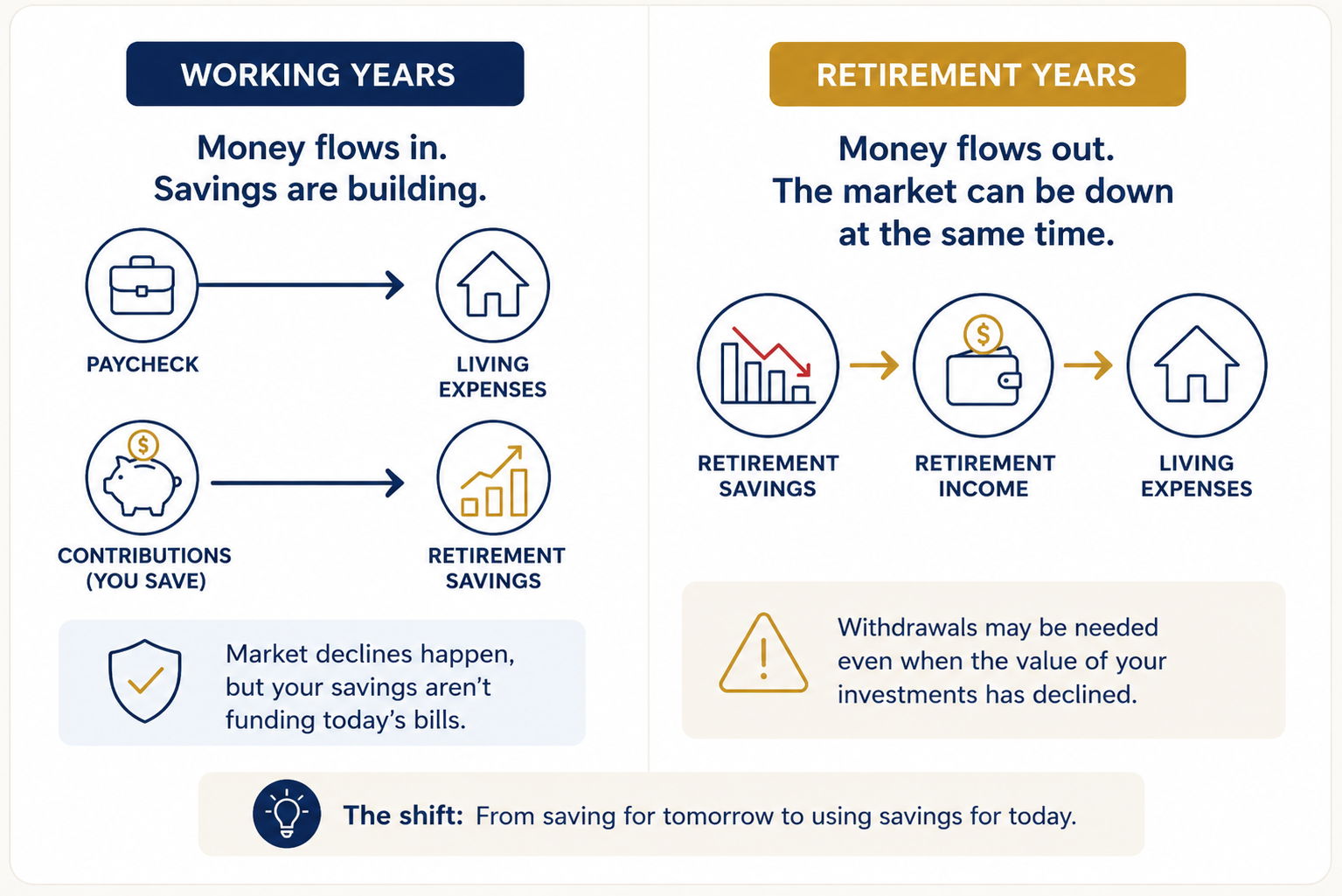
While you're working, the paycheck does an important job
Think about what happens during most of your working years.
Your paycheck pays the bills.
Your retirement accounts have a different job: they're accumulating money for later.
If the market falls, you may see the value of those accounts decline.
But assuming you don't need to withdraw the money, you may be able to leave the investments alone and give them time to recover.
You may even continue contributing while prices are lower.
That's an important distinction.
Your lifestyle isn't necessarily dependent on taking money out of the account while it's down.
Retirement can reverse the flow of money
When you retire, money can begin moving in the opposite direction.
Instead of:
Paycheck → Retirement Savings
you may begin relying on:
Retirement Savings → Retirement Paycheck
Now imagine a significant market decline.
Your account value falls.
But your mortgage or housing expenses still need to be paid.
You still need groceries.
Utilities still arrive.
You may still want to travel.
Healthcare expenses continue.
If some of that spending depends on withdrawals from market-based accounts, you may need money at the same time the account has declined.
That's what makes the retirement phase different.
A loss and a withdrawal can happen at the same time
Consider a simplified example.
Suppose someone enters retirement with $500,000 in an account they're planning to use for part of their retirement income.
For illustration only, imagine the account experiences a 20% decline.
Before considering any withdrawals, its value would fall from:
$500,000 → $400,000
Now suppose the retiree also needs to take money from that account to support their lifestyle.
The account isn't simply waiting for a future recovery.
Money is leaving it along the way.
This doesn't mean retirees should never take withdrawals from investments.
It means withdrawals change the mathematics of recovering from a decline.
Recovering from a loss already requires a larger percentage gain
Here's a useful piece of market math.
If an account falls 20%, it doesn't need a 20% gain to return to where it started.
A $500,000 account that declines 20% becomes $400,000.
For $400,000 to become $500,000 again, it needs to gain:
25%.
That's true even before considering withdrawals.
If money is also being removed from the account during the decline or recovery, there may be fewer dollars remaining to participate if the market later rises.
This is one reason retirement changes how we think about market risk.
The timing of returns can begin to matter more
Two retirees could experience similar average investment returns over a long period and still have different experiences.
Why?
Because when the positive and negative years occur can matter when withdrawals are being taken.
A difficult market early in retirement can create a different challenge than the same decline occurring many years later.
This idea has a name:
sequence-of-returns risk.
We'll explore it more closely in another lesson.
For now, the important idea is simpler:
Once withdrawals begin, the order in which market returns occur can matter—not just the average return.
Retirement doesn't mean avoiding the market entirely
Understanding this risk shouldn't lead to another extreme conclusion:
“Then I shouldn't have any money exposed to the market after I retire.”
That's not what this lesson is saying.
A retirement could last decades.
Some resources may still need the opportunity for growth.
Inflation may increase future expenses.
And different parts of your retirement savings may have different jobs.
The real question isn't whether the market is universally good or bad.
It's:
How much of your retirement lifestyle depends on taking money from market-based accounts regardless of what the market is doing?
That's a much more useful question.
Different retirement dollars can have different jobs
This is a theme you'll see throughout Blackburn's retirement education.
Not every retirement dollar needs to accomplish the same thing.
Some resources may be positioned for:
Income
Helping fund regular retirement expenses.
Liquidity
Remaining accessible for unexpected needs and opportunities.
Growth
Having the opportunity to increase over time.
Protection or guarantees
Providing greater predictability for particular parts of the retirement plan.
Those jobs can overlap, but they aren't identical.
Understanding what you need each portion of your savings to accomplish can make market risk easier to evaluate than simply asking:
“How much risk should I take?”
Start with the income you actually need
One way to make this conversation more practical is to begin with your retirement expenses rather than your investment balance.
Ask:
How much do we expect to spend each month?
Then:
How much of that is already covered by dependable income sources?
For example, suppose a household expects to need $7,000 per month.
Social Security and other dependable income provide $4,500.
That leaves:
$2,500 per month
that needs to come from somewhere else.
Now the market-risk conversation becomes more specific.
Instead of only asking whether a $500,000 or $1 million portfolio is “safe,” you can begin asking:
How much of our $2,500 monthly income gap depends on withdrawing money from accounts whose values can fluctuate?
That connects investment risk directly to the retirement paycheck.
Market risk feels different when time isn't the only answer
During your working years, a common response to a market decline is:
“I have time to wait.”
That may still be partly true in retirement.
But retirement adds another question:
“What am I living on while I wait?”
That's the transition worth understanding.
A retiree may still have a long investment horizon.
But some of the money may also have a short-term job—helping pay today's expenses.
Good retirement-income planning recognizes both realities.
Bringing It Together
Market risk doesn't suddenly become dangerous simply because you retire.
What changes is your relationship with your retirement savings.
While you're working, your paycheck may allow your retirement accounts to remain invested through difficult markets.
Once those accounts begin helping create your retirement paycheck, declines and withdrawals can occur at the same time.
That makes questions about income, timing, liquidity, growth and protection increasingly connected.
The goal isn't to eliminate every market fluctuation.
It's to understand which parts of your retirement lifestyle depend on money exposed to those fluctuations—and whether the different parts of your savings are doing the jobs you need them to do.
Continue Your Retirement Income Education
Explore related lessons to keep building your retirement-income picture.
What Is Sequence-of-Returns Risk?
See why the order of market gains and losses can matter once retirement withdrawals begin.
Read the lesson →What Determines How Long Retirement Savings Last?
Explore the different forces that can affect how long retirement resources may need to support you.
Read the lesson →Income That Lasts vs. Purchasing Power That Lasts
Learn why protecting today's income amount and maintaining tomorrow's purchasing power aren't necessarily the same challenge.
Read the lesson →See Your Retirement Income Picture
Your retirement isn't just an account balance. See how your income, savings and retirement priorities fit together.