
Protecting Your Retirement · 7 min read
What Determines How Long Retirement Savings Last?
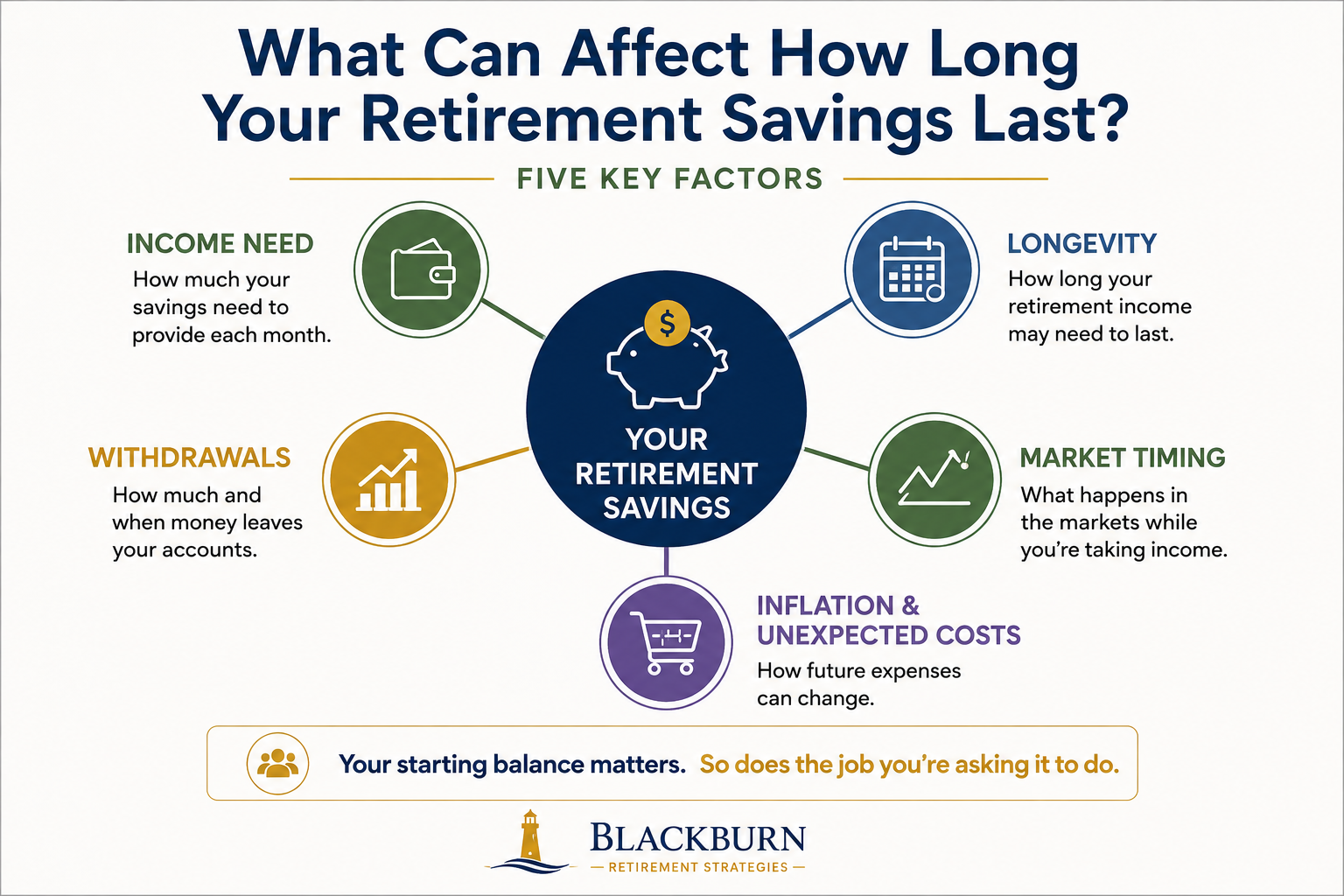
Your starting balance matters. But how much you need, how long you need it, and what happens along the way can matter just as much.
One of the most natural questions approaching retirement is:
“Do I have enough?”
It's an important question, but an account balance alone can't answer it.
Two people could retire with exactly the same amount of savings and have very different outcomes. One may need substantially more from those savings each month. One may retire earlier. One may encounter difficult markets early in retirement. One may face larger healthcare expenses. And both may experience inflation over a retirement that lasts decades.
So a better question is often:
“What will determine how long my savings need to support me—and how hard will those savings have to work?”
Understanding those forces is an important part of turning retirement savings into retirement income.
1. Start with what your savings actually need to provide
A $750,000 retirement account doesn't tell you whether it's enough until you know what you're asking it to do.
Imagine two retired households that each begin with $750,000 in retirement savings.
One receives enough dependable income from Social Security and other sources to cover most of its regular expenses. Its savings may only need to supplement that income.
The other household depends much more heavily on its savings to pay monthly expenses.
Same starting balance. Different job.
That's why one of the first useful numbers in retirement-income planning is the difference between the income you expect to need and the dependable income you already expect to receive.
If a household wants $7,000 per month and has $5,500 coming from dependable sources, its savings may need to help address a $1,500 monthly gap.
If dependable income is only $3,500, that gap becomes $3,500.
The starting account balance hasn't changed.
What you're asking that account to provide has.
2. How long might retirement last?
No one knows exactly how long they'll live.
That uncertainty makes retirement different from many other financial goals.
If you're saving for a vacation or a vehicle, you can usually identify approximately when you'll need the money and how much the purchase will cost.
Retirement doesn't come with a known ending date.
Someone retiring at 65 may need income for 20 years, 25 years, 30 years or longer.
That doesn't mean you should try to predict your lifespan.
It means your retirement-income plan should recognize that living longer is a financial consideration as well as something to hope for.
The longer retirement lasts, the longer your income sources and savings may need to support your lifestyle.
3. How much you take out matters
Once retirement savings begin helping pay the bills, money is flowing in the opposite direction from your working years.
Instead of regularly contributing to an account, you may regularly withdraw from it.
The amount matters.
But so does the pattern.
Regular monthly income, occasional travel, a new vehicle, home repairs and unexpected expenses can all place different demands on savings.
This is why simply choosing a percentage to withdraw doesn't tell the whole story.
Your retirement spending may not be perfectly level every year.
The important concept is straightforward:
The more of your lifestyle your savings must support, the more important it becomes to understand how those withdrawals interact with the rest of your plan.
4. The order of market returns can matter
Suppose two retirees experience similar long-term average investment returns.
It might seem reasonable to assume they would have similar retirement outcomes.
Not necessarily.
If one experiences strong markets early in retirement and difficult markets later, while another experiences the same general results in the opposite order, their outcomes can differ—especially if both are withdrawing money along the way.
Why?
Because withdrawals made after a market decline can leave fewer dollars participating if markets later recover.
This is known as sequence-of-returns risk.
You don't need to predict when the next market decline will happen to understand the lesson:
Taking income from fluctuating assets introduces a different challenge than simply leaving money invested for future growth.
We'll cover sequence-of-returns risk more deeply in a separate Blackburn lesson.
5. Inflation changes what your income can buy
Imagine retirement begins with monthly expenses of $6,000.
Even if your lifestyle doesn't become more extravagant, there's a good chance the same groceries, utilities, insurance, travel and everyday purchases will cost more years from now.
That's inflation.
This creates two different retirement-income questions:
Will my income continue?
and
Will that income continue buying what I need?
Those aren't exactly the same question.
A retirement plan may need to support you for decades, which gives even relatively modest increases in prices time to compound.
That's why planning for retirement income isn't only about creating today's paycheck.
It's also about considering tomorrow's purchasing power.
6. Real life rarely follows a perfect spending plan
Retirement projections can look wonderfully orderly on paper.
Real retirement isn't always orderly.
A roof needs replacing.
A vehicle needs to be purchased.
Family needs help.
Travel costs more than expected.
A spouse's circumstances change.
Healthcare expenses appear.
None of those automatically means a retirement plan has failed.
They simply illustrate why flexibility matters.
Some retirement dollars may need to remain accessible precisely because not every future expense can be predicted today.
A plan built only around the expected monthly bills can miss the expenses that don't arrive every month.
7. These forces don't operate separately
Imagine someone who:
- retires earlier than expected,
- needs more monthly income from savings,
- experiences a significant market decline early in retirement,
- and then sees everyday expenses rise over the following decade.
Those aren't four isolated issues.
They interact.
A larger income need means more money may be withdrawn.
A market decline can reduce the account those withdrawals are coming from.
Inflation can increase the amount of income needed later.
And longevity determines how long the entire system may need to continue working.
That's why retirement-income planning is less about finding one magical number and more about understanding how the pieces work together.
Bringing It Together
How long retirement savings last isn't determined by the starting balance alone.
It also depends on how much income those savings need to provide, how long retirement lasts, what happens in the markets while withdrawals are being made, how purchasing power changes and what unexpected expenses arise along the way.
You can't know every variable in advance.
But you can understand the forces your retirement income plan may need to handle.
And that moves the conversation beyond simply asking:
“How much have I saved?”
toward the more useful question:
“What does this money need to accomplish for me?”
Continue Your Retirement Income Education
Explore related lessons to keep building your retirement-income picture.
What Is Sequence-of-Returns Risk?
See why the timing of market gains and losses can matter when you're withdrawing retirement income.
Read the lesson →Income That Lasts vs. Purchasing Power That Lasts
Understand why receiving income and maintaining what that income can buy are different challenges.
Read the lesson →Retirement Savings and Retirement Income Aren't the Same Thing
Return to the foundation for understanding the transition from accumulation to income.
Read the lesson →See Your Retirement Income Picture
Your retirement isn't just an account balance. See how your income, savings and retirement priorities fit together.