
Protecting Your Retirement · 7 min read
What Is Sequence-of-Returns Risk?
The average return on your retirement savings matters. But once you're taking withdrawals, the order in which those returns occur can matter too.
Imagine two people retiring with the same amount of money.
They withdraw the same amount.
Their investments experience the same set of annual returns.
There's just one difference:
Those returns happen in a different order.
It might seem like both retirees should end up in roughly the same place.
But once withdrawals begin, they may not.
That's the idea behind sequence-of-returns risk.
Before withdrawals, the order matters less
Here's a simplified way to understand the concept.
Suppose an account experiences three annual returns:
+10%
+5%
−15%
Now reverse their order:
−15%
+5%
+10%
If no money is added or removed along the way, the ending result is essentially the same.
The account experienced the same three returns.
They simply arrived in a different sequence.
But retirement introduces something that can change the outcome:
withdrawals.
Withdrawals change the equation
Once an account is helping fund your retirement, money may be coming out every month or every year.
Now imagine a significant market decline occurs early in retirement.
The account falls in value.
But you still need income.
If you withdraw money from the account while its value is down, there are fewer dollars remaining to participate in a future recovery.
That's what makes the sequence important.
It's not simply:
Did the market eventually recover?
It's also:
How much money was still invested when it did?
Same returns. Different order. Different experience.
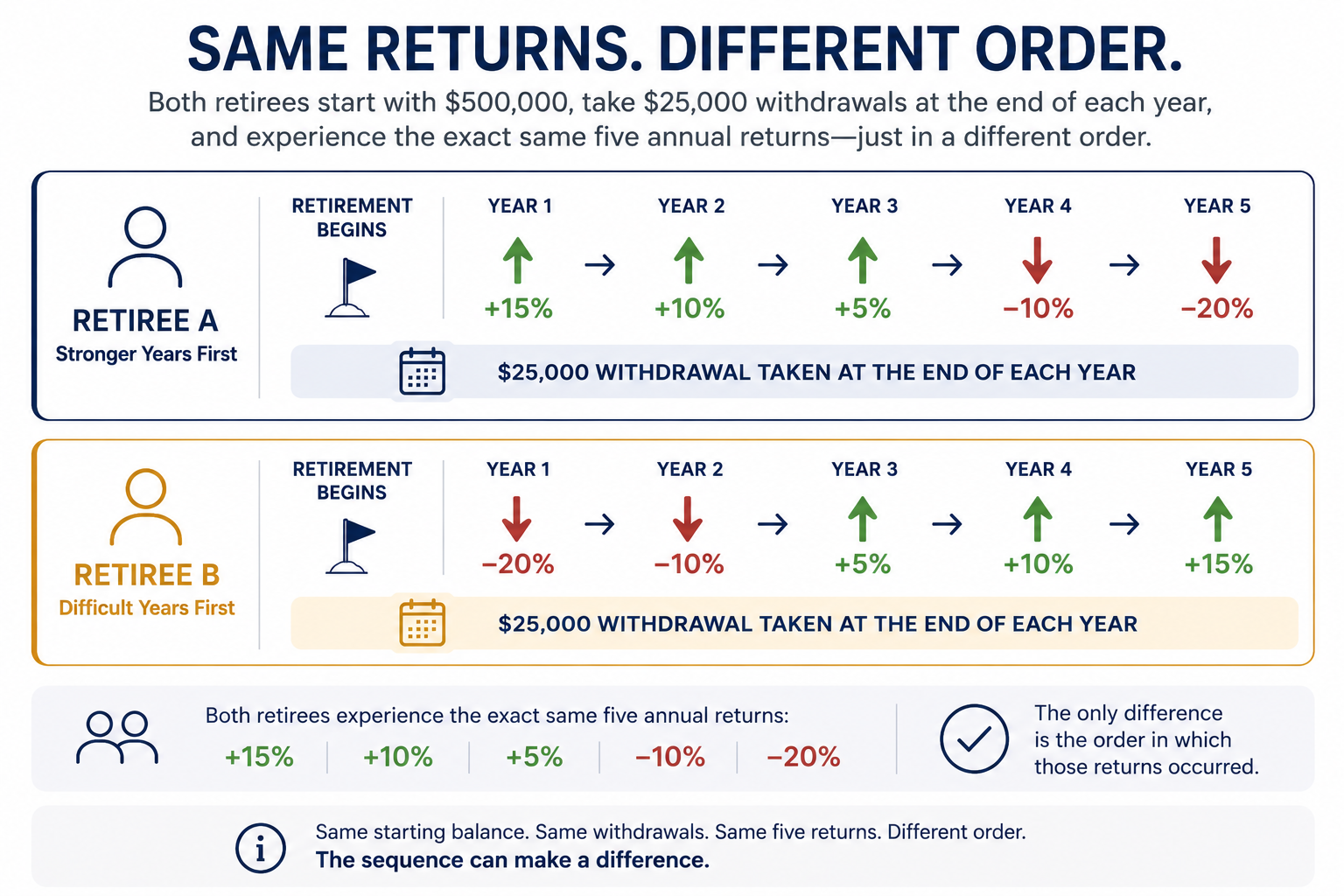
Consider two hypothetical retirees.
We'll call them Retiree A and Retiree B.
Both begin retirement with the same savings.
Both need regular withdrawals to help fund their lifestyle.
Over several years, both experience the same collection of positive and negative market returns.
But Retiree A experiences the stronger years earlier.
Retiree B experiences the market declines earlier.
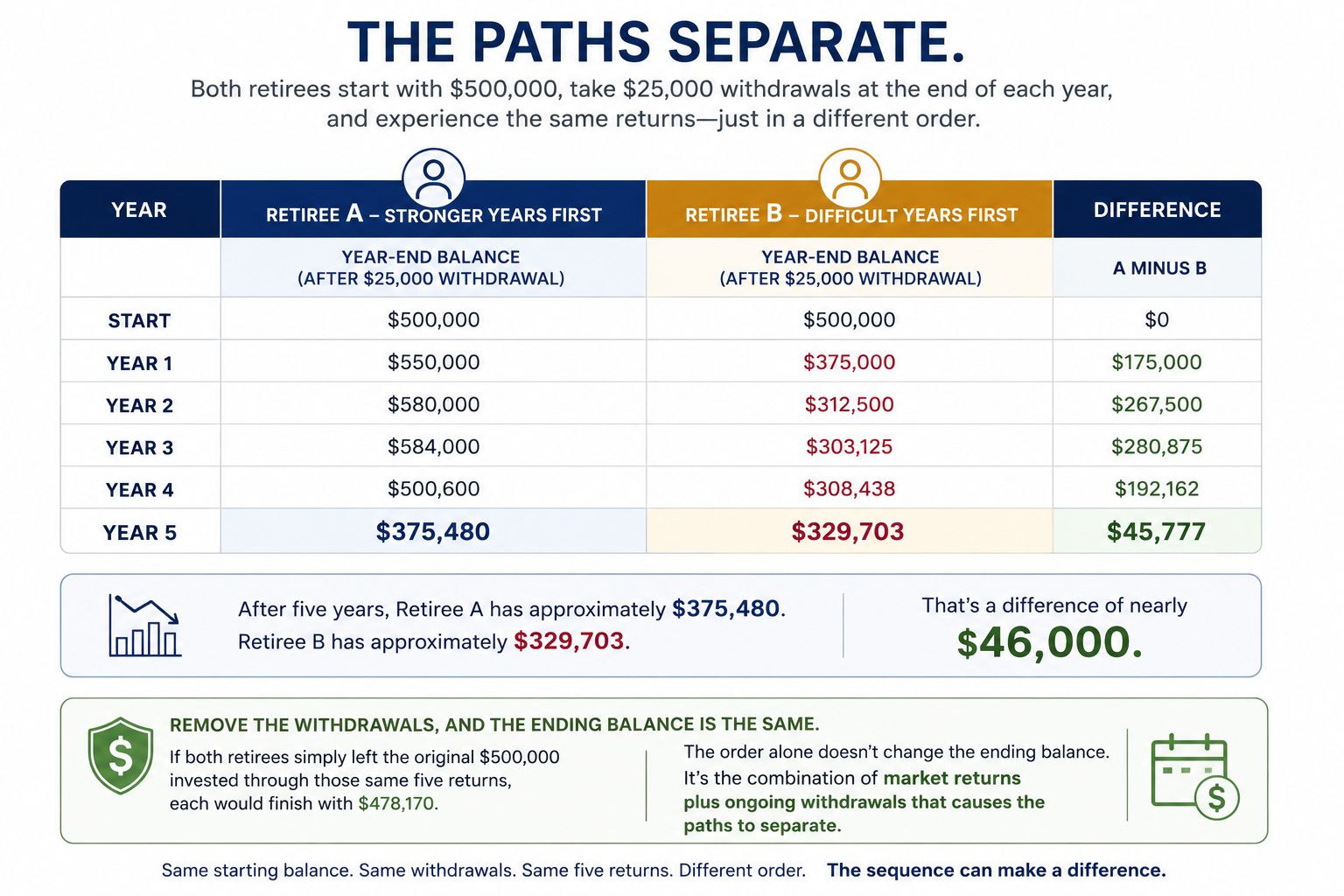
Even if their average returns eventually look similar, Retiree B may have had to make withdrawals from a smaller account during those difficult early years.
That can leave less money available when better markets eventually arrive.
Same returns. Different sequence. Potentially different result.
Early retirement can be an especially important period
A market decline at age 45 and a market decline shortly after retirement aren't necessarily the same financial event.
At 45, you may still have:
- years of employment ahead,
- continued retirement contributions,
- a paycheck funding your lifestyle,
- and substantial time before withdrawals begin.
Shortly after retirement, the situation may be different.
Your paycheck may have stopped.
Contributions may have stopped.
And withdrawals may have begun.
A difficult market during those early retirement years can therefore affect both:
the value of the account
and
the amount that must continue supporting future withdrawals.
The problem isn't simply that markets decline
Markets have always moved up and down.
Sequence-of-returns risk doesn't mean a retiree must somehow avoid every market decline.
That's unrealistic.
The issue is the combination of two things happening at once:
Market values fall
while
retirement withdrawals continue.
That combination can make an early decline more consequential than the same decline occurring when withdrawals aren't being taken.
Average return doesn't tell the whole story
People naturally focus on average investment returns.
That's understandable.
Average return is useful information.
But averages can hide the path taken to get there.
Imagine being told that a retirement account averaged a certain return over 20 years.
That tells you something about performance.
It doesn't tell you:
- when the difficult years occurred,
- when withdrawals were taken,
- how much was withdrawn,
- or how much remained invested after those withdrawals.
For someone accumulating money, that distinction may be less important.
For someone spending from the account, it can become much more important.
This connects directly to your retirement paycheck
Sequence risk becomes easier to understand when we stop thinking only about investment balances and start thinking about income.
Suppose your retirement lifestyle requires:
$7,000 per month
And dependable sources such as Social Security provide:
$4,500 per month
That leaves a:
$2,500 monthly income gap
If that $2,500 must consistently come from accounts exposed to market fluctuations, withdrawals may continue whether the market is rising or falling.
Now the question isn't simply:
“What return might my investments earn?”
It also becomes:
“What happens to my retirement paycheck if a difficult market arrives early?”
That's a retirement-income question.
Different dollars can help handle different jobs
As we've discussed throughout Blackburn's retirement education, not every retirement dollar has to perform the same job.
Some resources may be intended to provide growth potential.
Some may provide liquidity.
Some may help create dependable income.
Some may provide guarantees or protection for particular retirement needs.
The purpose of understanding sequence risk isn't to prescribe exactly where each dollar should go.
It's to recognize that depending on one fluctuating pool of money for every retirement need can expose your income to the timing of market returns.
Understanding that tradeoff can help you ask better questions about how your retirement resources are organized.
Sequence risk doesn't tell you what the market will do
There's another important distinction.
Understanding sequence-of-returns risk doesn't help anyone predict the next market decline.
That's not the point.
No one knows exactly when the strongest or weakest market years will occur.
Sequence risk is about preparing for that uncertainty rather than predicting it.
Useful questions include:
- How much of our regular retirement spending depends on market withdrawals?
- Which expenses must be paid regardless of market conditions?
- What dependable income do we already have?
- How much flexibility do we have in our withdrawals?
- What resources are available if markets decline?
- Which parts of our savings need growth, liquidity, income or protection?
Those questions focus on what you can plan for rather than what you can't predict.
Bringing It Together
Sequence-of-returns risk sounds complicated, but the underlying idea is straightforward:
Once withdrawals begin, when market gains and losses happen can matter.
Two retirees can experience similar long-term returns and still have different outcomes if one encounters difficult markets earlier while withdrawing money.
That doesn't mean retirees should try to predict markets or eliminate every investment risk.
It means retirement-income planning should consider more than an expected average return.
Your savings need to support your life through whatever sequence the market actually delivers.
Continue Your Retirement Income Education
Explore related lessons to keep building your retirement-income picture.
Why Market Risk Changes When You Start Taking Income
Understand the broader reason market declines can affect retirees differently than people who are still accumulating.
Read the lesson →What Determines How Long Retirement Savings Last?
Explore the different factors that can influence how long retirement resources need to support you.
Read the lesson →Growth, Protection, Liquidity and Guarantees Have Different Jobs
See why retirement resources don't necessarily all need to accomplish the same thing.
See Your Retirement Income Picture
Your retirement isn't just an account balance. See how your income, savings and retirement priorities fit together.