
Understanding Retirement · 7 min read
Your Retirement Income and Your Spendable Income Aren't Always the Same
Knowing how much retirement income you expect is important. Knowing how much of it may actually be available for your lifestyle is even more useful.
During your working years, you're probably already familiar with the difference between what you earn and what reaches your bank account.
Your salary might be $100,000.
But you don't have $100,000 available to spend.
Taxes, insurance premiums, retirement contributions and other deductions can reduce what ultimately reaches your household.
Retirement changes the sources of your income.
It doesn't eliminate the distinction between income received and income available to spend.
That's why a retirement-income plan shouldn't stop at:
“How much income will I receive?”
It should eventually ask:
“How much of that income will actually be available to support my retirement?”
1. Gross income is a starting point
Suppose a retired household expects income from several sources.
For a simplified illustration:
Social Security: $4,000/month
Pension: $1,000/month
Other retirement income: $2,000/month
That creates:
$7,000/month of gross retirement income
At first glance, a household expecting to spend $7,000 per month might think the income picture fits perfectly.
But $7,000 coming in doesn't automatically mean $7,000 is available for lifestyle expenses.
There can still be amounts that need to come out.
That's where spendable income becomes useful.
2. Your retirement paycheck may still have deductions
The deductions may look different from those on your working paycheck.
But retirement income can still be affected by things such as:
- federal income taxes,
- state income taxes where applicable,
- Medicare premiums,
- healthcare-related premiums,
- and other recurring obligations.
Exactly how those items affect a household depends on its individual circumstances.
The purpose here isn't to calculate them.
It's to recognize that they exist.
If your retirement plan requires $7,000 each month for your lifestyle, the income needed to support that lifestyle may need to be more than $7,000 before deductions.
3. Different income sources can be treated differently
This is where retirement income can become more complicated than a working paycheck.
Money may eventually come from:
- Social Security,
- pensions,
- traditional retirement accounts,
- Roth accounts,
- bank savings,
- annuities,
- taxable investment accounts,
- or other sources.
Those dollars don't necessarily receive identical tax treatment.
And the rules can depend on factors that are specific to the household.
That means two retirees who each receive $7,000 per month could potentially have different amounts available to spend.
Same gross income. Different spendable income.
You don't need to become a tax expert to understand why that distinction matters.
You simply need to recognize that the source of retirement income can affect the amount that ultimately supports your lifestyle.
4. A simple example shows the difference
Let's keep the math deliberately simple.
Suppose a household wants:
$6,000 per month
available for its regular retirement lifestyle.
Now suppose various taxes, healthcare premiums and other deductions total approximately:
$1,000 per month
for this hypothetical example.
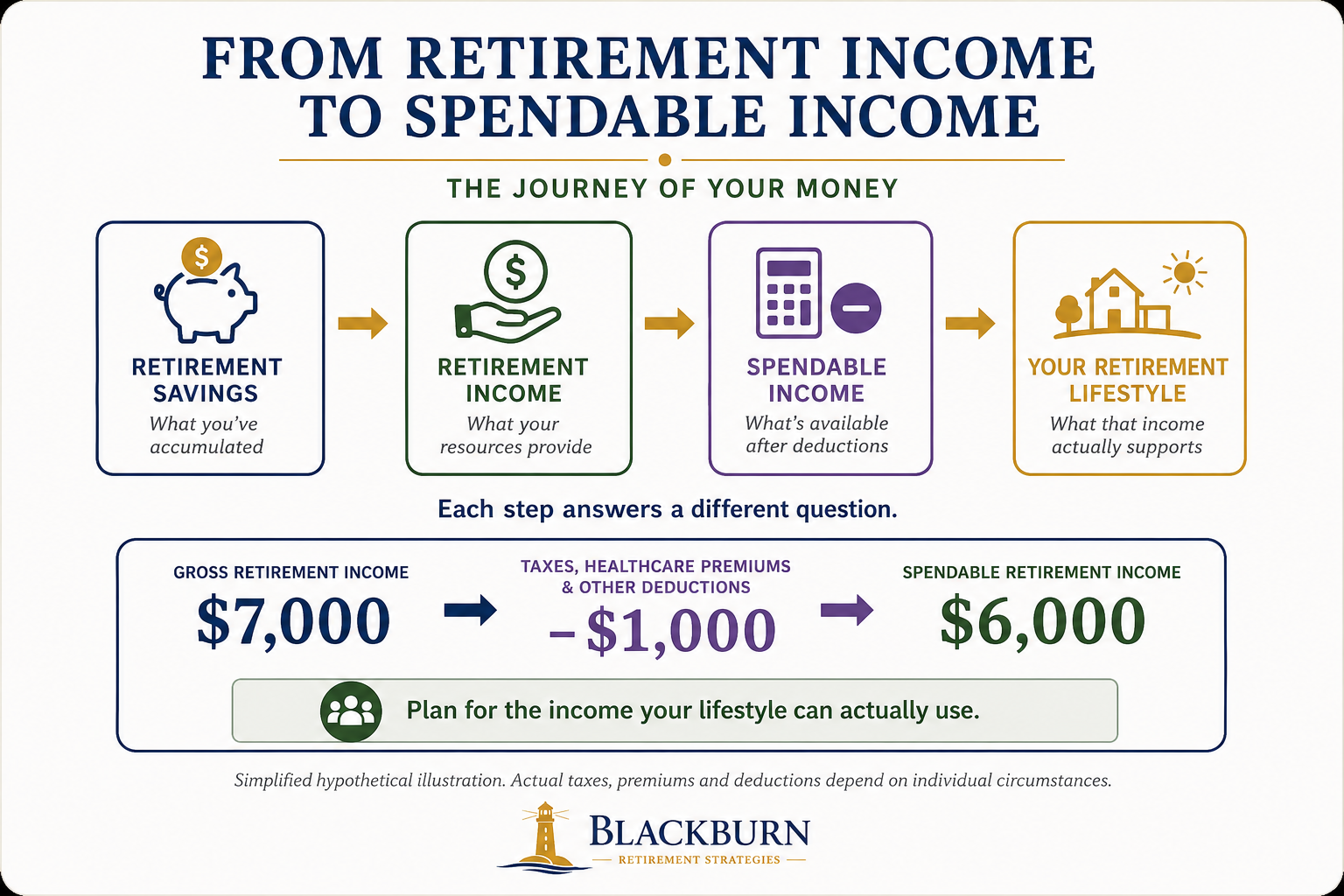
The household doesn't really need $6,000 of gross income to have $6,000 available to spend.
It would need approximately:
$7,000 gross retirement income
minus
$1,000 deductions
to produce
$6,000 spendable income
This is not a tax calculation or recommendation.
It's simply a way to illustrate an important distinction:
The retirement paycheck you need before deductions may be different from the amount you need after them.
5. This can affect the income gap
This connects directly to the retirement-paycheck concept from BR-07.
Imagine a household determines that it wants:
$6,000 of spendable monthly income.
After considering expected deductions, it estimates that it may need approximately:
$7,000 of gross monthly income
to support that goal.
Now suppose Social Security and another dependable income source provide:
$4,500 per month of gross income.
The household shouldn't automatically calculate its income gap as:
$6,000 − $4,500.
Those numbers represent two different things.
One is a spendable-income goal.
The other is gross income.
Before deciding what retirement savings need to provide, the household needs to compare numbers on the same basis.
That's an easy detail to miss—and an important one.
6. Taxes aren't necessarily fixed throughout retirement
Another reason to avoid assuming gross income equals spendable income is that retirement can last decades.
Income can change.
Tax laws can change.
Household circumstances can change.
A household may eventually experience the loss of a spouse.
Required distributions from certain retirement accounts may eventually become relevant.
Healthcare-related premiums can change.
The mix of income sources can change.
So the objective isn't to calculate one tax number at retirement and assume it will remain perfectly accurate for the next 30 years.
It's to recognize that spendable income can change even when the gross-income number looks similar.
Questions involving individual tax consequences should be evaluated with an appropriate tax professional.
7. Planning in spendable dollars can make retirement feel more real
Account balances can feel abstract.
Gross-income projections can too.
Spendable income brings the conversation closer to everyday life.
Your mortgage or housing expenses are paid with spendable dollars.
Groceries are bought with spendable dollars.
Travel is paid for with spendable dollars.
Utilities, hobbies, gifts, home repairs and everyday life all depend on what's actually available to the household.
That's why a retirement-income plan becomes more useful when it eventually connects:
YOUR RETIREMENT MONEY AT WORK
Each step answers a different question.
8. Start by keeping the numbers straight
You don't need to calculate your future tax return today.
But when evaluating a retirement-income picture, it helps to know which number you're looking at.
Ask:
Is this gross income or spendable income?
Are the expenses we're comparing it against before-tax or after-tax needs?
Could healthcare premiums or other deductions reduce what's available?
Are different income sources likely to be treated differently?
Do we need a tax professional to evaluate the tax consequences of a particular decision?
Those questions can prevent a retirement plan from appearing more comfortable on paper than it may feel in real life.
Bringing It Together
Your retirement-income number and your spendable-income number aren't necessarily the same.
Taxes, healthcare premiums and other deductions can affect how much of your retirement paycheck is actually available to support your lifestyle.
And because different income sources and household circumstances can be treated differently, two households with the same gross retirement income may not have the same amount available to spend.
You don't need to predict every future deduction today.
You do need to know which number you're planning around.
The goal isn't simply:
“How much retirement income will I have?”
It's:
“How much of that income may actually be available to support the retirement I want?”
Continue Your Retirement Income Education
Explore related lessons to keep building your retirement-income picture.
How Social Security Fits Into Your Retirement Paycheck
See how Social Security can become one part of the income your retirement requires.
Read the lesson →Healthcare and Your Retirement Paycheck
Understand why healthcare belongs in the retirement-income calculation rather than sitting outside it.
Read the lesson →Retirement Savings and Retirement Income Aren't the Same Thing
Return to the foundation for understanding the transition from accumulating money to using it for income.
Read the lesson →See Your Retirement Income Picture
Your retirement isn't just an account balance. See how your income, savings and retirement priorities fit together.