
Social Security & Medicare · 7 min read
How Social Security Fits Into Your Retirement Paycheck
Social Security may provide an important foundation for retirement income. The bigger question is how it fits with the rest of the income your retirement will require.
For most of your working life, income has a familiar source.
A paycheck arrives.
You use it to pay the mortgage or rent, buy groceries, cover utilities, travel, save and handle the rest of everyday life.
Retirement changes where that paycheck comes from.
Instead of relying primarily on an employer, your retirement income may eventually come from several places.
Social Security may be one of the most important.
But knowing your estimated Social Security benefit doesn't necessarily tell you whether your retirement income picture is complete.
A more useful question is:
“How much of the retirement paycheck I need will Social Security provide—and where will the rest come from?”
That turns Social Security from an isolated benefit into part of a larger retirement-income plan.
1. Start with the retirement paycheck you need
It's tempting to begin retirement planning with your account balances.
But for this conversation, let's begin somewhere else:
your monthly income.
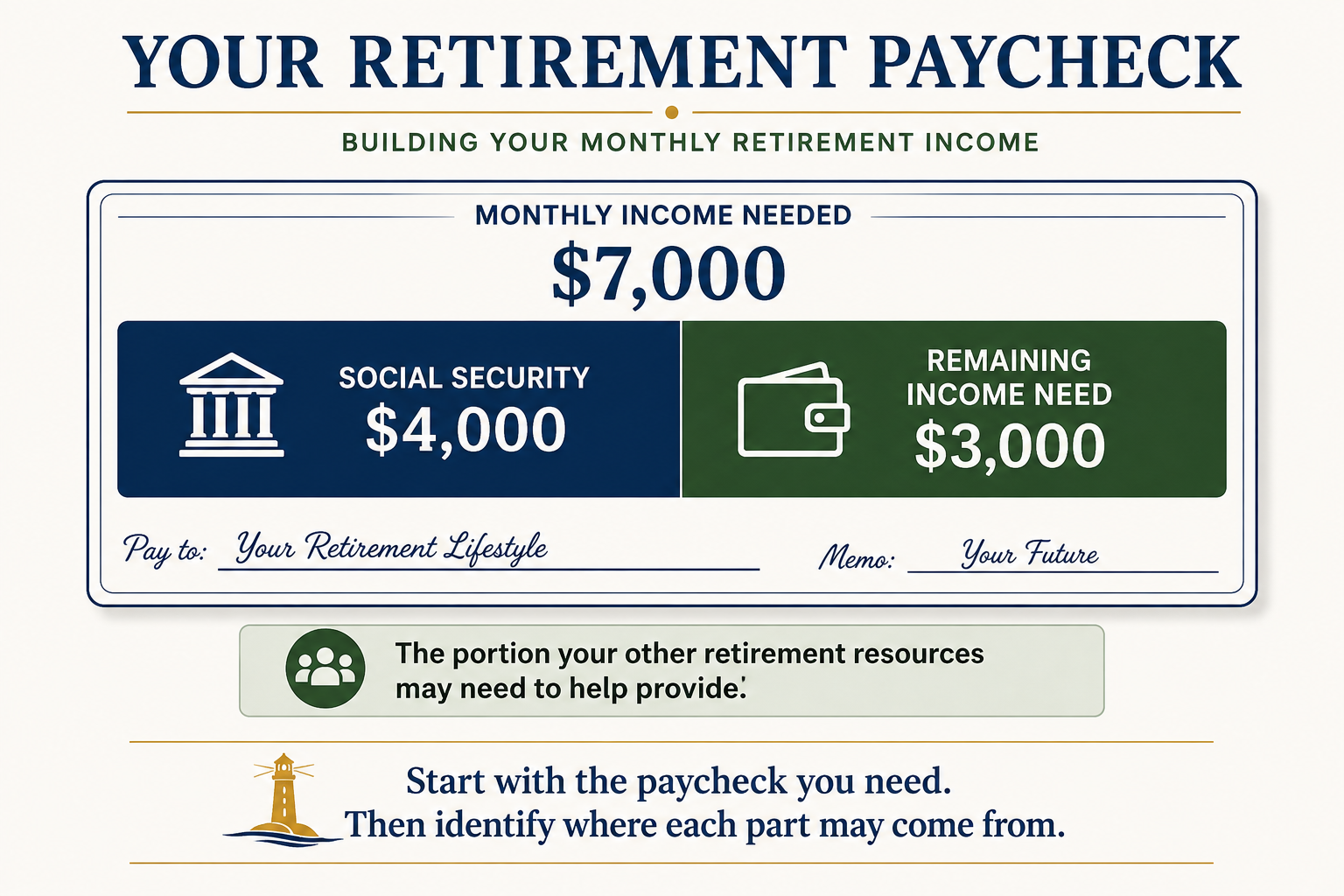
Suppose a household expects to need about $7,000 per month to support the retirement lifestyle it has planned.
That becomes the starting target.
Now we can begin identifying where that $7,000 might come from.
If Social Security provides part of it, that portion of the monthly spending need may no longer have to be created entirely from retirement savings.
This is why Social Security matters beyond simply knowing the amount of your benefit.
It helps define the job your other retirement resources may need to do.
2. Social Security can become part of your income foundation
Imagine that same household needs $7,000 per month.
Together, the spouses expect $4,000 per month from Social Security.
For a simplified illustration:
Monthly income needed: $7,000
Social Security: $4,000
Remaining income need: $3,000
That remaining $3,000 is where the rest of the retirement-income picture becomes important.
It may need to come from pensions, retirement accounts, savings, annuities or other available resources.
The point isn't that every household should fill that gap the same way.
They shouldn't.
The point is that once you know what dependable income is already expected, you can better understand what the rest of your money is being asked to accomplish.
3. A benefit amount and an income plan aren't the same thing
Someone might say:
“I'll receive $3,000 per month from Social Security.”
That's useful information.
But by itself, it doesn't answer:
- How much will I need each month?
- What income will my spouse receive?
- What regular expenses will Social Security cover?
- How much will still need to come from savings?
- Which expenses might increase later?
- What happens if retirement lasts 25 or 30 years?
- What happens to household income after the loss of a spouse?
Those are retirement-income questions.
Social Security helps answer part of them.
It doesn't automatically answer all of them.
4. When you claim can affect the amount you receive
Social Security retirement benefits can generally begin before full retirement age, at full retirement age or later.
The age at which benefits begin can affect the monthly amount.
Starting earlier generally means accepting a lower monthly retirement benefit than waiting until full retirement age.
Waiting beyond full retirement age can generally increase the monthly retirement benefit up to the applicable limit under Social Security rules.
That makes timing important.
But timing shouldn't be reduced to a universal rule such as:
“Always claim as early as possible.”
or
“Always wait as long as possible.”
Individual circumstances differ.
Health, employment, other income resources, household needs, marital circumstances and longevity considerations can all be part of the conversation.
For Blackburn's purposes, the important educational principle is:
When Social Security begins can affect how much of your retirement paycheck it may provide.
Specific claiming decisions should be evaluated using your individual circumstances and current Social Security rules.
5. Social Security and your savings can affect each other's jobs
Imagine someone plans to retire before beginning Social Security.
Their retirement savings may temporarily need to provide more of their monthly income.
Once Social Security begins, the amount those savings need to provide could change.
Or imagine someone begins Social Security immediately when retiring.
Their savings may need to fill a smaller income gap from the beginning.
Neither example automatically tells us which choice is better.
It shows something more important:
Your income sources don't operate independently.
Changing when one source begins can change what another source needs to provide.
That's why Social Security decisions make more sense when viewed as part of the entire retirement-income picture rather than as a stand-alone decision.
6. Couples have another layer to consider
For married couples, Social Security is not simply two unrelated monthly deposits.
Each spouse may have a different benefit.
They may be different ages.
They may retire at different times.
And eventually, one spouse may outlive the other.
That makes another question important:
“What happens to our household retirement income when only one of us is here?”
A surviving spouse generally doesn't continue receiving both Social Security retirement benefits exactly as they were being paid while both spouses were alive.
Depending on the circumstances and applicable Social Security rules, survivor benefits may replace one of those income streams.
At the same time, many household expenses don't fall by half after the loss of a spouse.
Housing costs may remain.
Utilities remain.
Property taxes and insurance remain.
Transportation, healthcare and everyday living expenses continue.
So a retirement-income plan for a couple should eventually consider not only:
What income do we have together?
but also:
What might the income picture look like for the surviving spouse?
We'll explore that question more deeply in our lesson on household retirement security.
7. Social Security may change over time
Social Security retirement benefits can receive cost-of-living adjustments.
Those adjustments are intended to help benefits respond to changes in the cost of living.
That can make Social Security different from a retirement-income source that simply remains at the same dollar amount indefinitely.
But that doesn't mean Social Security will necessarily keep pace with every expense a household experiences.
Different costs can change at different rates.
Healthcare, insurance, housing and other expenses may behave differently over a long retirement.
So the useful question isn't simply:
“Does Social Security increase?”
It's:
“How does Social Security fit with the rest of the income and expenses we may have over time?”
8. Build the picture from the dependable income outward
A simple way to organize the retirement-income conversation is:
Step 1: Estimate the retirement income you expect to need.
Then:
Step 2: Identify the dependable income you expect to receive.
Social Security may be a major part of that second number.
Then:
Step 3: Calculate the remaining income need.
For example:
Retirement income target: $7,000/month
Social Security: $4,000/month
Other dependable income: $500/month
Remaining income need: $2,500/month
Now the retirement-savings question becomes much more useful.
Instead of asking only:
“Is $750,000 enough?”
you can begin asking:
“Can our retirement resources reasonably support the remaining $2,500 monthly income need while also providing the flexibility, liquidity and future purchasing power we may need?”
That's a much clearer job description for your savings.
9. Social Security is important—but it is one piece
For many retirees, Social Security may become one of the most dependable parts of their retirement income.
That's significant.
But retirement still involves more than one monthly deposit.
Your retirement paycheck may eventually need to account for:
- everyday living expenses,
- healthcare,
- inflation,
- unexpected expenses,
- longevity,
- market conditions,
- taxes,
- and the needs of a surviving spouse.
Social Security can help provide a foundation.
The rest of your retirement resources may need to build around it.
Bringing It Together
Social Security can be an important part of your retirement paycheck.
But the benefit amount becomes much more meaningful when you put it beside the income your retirement will actually require.
Start with the paycheck you expect to need.
Identify how much dependable income Social Security and other sources may provide.
Then look at the gap that remains.
That gap helps define the job your retirement savings may need to do.
The goal isn't simply to answer:
“How much Social Security will I receive?”
It's to understand:
“How does Social Security fit into the retirement paycheck that will support my life?”
Continue Your Retirement Income Education
Explore related lessons to keep building your retirement-income picture.
Retirement Savings and Retirement Income Aren't the Same Thing
See why building savings and turning those savings into a retirement paycheck are two different challenges.
Read the lesson →What Determines How Long Retirement Savings Last?
Explore the forces that can affect how hard your retirement savings may need to work.
Read the lesson →Does Your Retirement-Income Plan Still Work for One?
See why couples should consider what the household income picture could look like after the loss of a spouse.
Read the lesson →See Your Retirement Income Picture
Your retirement isn't just an account balance. See how your income, savings and retirement priorities fit together.