
Legacy & Estate Planning · 7 min read
Does Your Retirement-Income Plan Still Work for One?
A retirement-income plan built for two people should also consider what the financial picture could look like when only one spouse remains.
Most married couples plan retirement together.
They think about when they'll retire.
Where they'll live.
How much they'll travel.
What they'll spend.
And how their combined savings and income will support the life they've planned.
But there's another retirement-income question that's much harder to think about:
“Would our plan still work financially if one of us had to live it alone?”
Eventually, most married couples will face a period when only one spouse remains.
When that happens, household expenses don't necessarily fall by half.
But household income can change.
Understanding that possibility isn't about being pessimistic.
It's about making sure a retirement-income plan considers both people's futures—not just the years they'll spend together.
1. Two people can create one household paycheck
Imagine a retired couple whose monthly income looks like this:
Spouse A Social Security: $2,500
Spouse B Social Security: $2,000
Other dependable income: $1,500
Together:
$6,000 per month
Their retirement lifestyle has been built around that household income.
Housing.
Utilities.
Groceries.
Insurance.
Transportation.
Travel.
Healthcare.
Everything fits into one household budget.
While both spouses are alive, it's natural to think of that $6,000 as their retirement paycheck.
But eventually the household may need to operate with a different income picture.
2. Some income may change after one spouse passes away
After one spouse passes away, not every retirement-income source necessarily continues exactly as it did before.
Social Security is an important example.
A surviving spouse generally doesn't simply continue receiving both spouses' retirement benefits in full.
Depending on the circumstances and current Social Security rules, survivor benefits may replace one of the previous benefits.
Pension income can also depend on the survivor option selected.
Other income sources may have their own rules.
The important educational point isn't to calculate exactly what a particular surviving spouse will receive.
It's to recognize this:
Household retirement income can change after the loss of a spouse.
That possibility belongs in the retirement-income conversation before it happens.
3. Expenses usually don't fall by 50%
After the loss of a spouse, there is one fewer person in the household.
Some expenses may decline.
Groceries may cost less.
Travel or entertainment spending may change.
Certain healthcare expenses associated with the spouse who passed away disappear.
But many major expenses may remain surprisingly similar.
The surviving spouse may still have:
- the same house,
- the same property taxes,
- the same homeowners insurance,
- many of the same utilities,
- a vehicle,
- home maintenance,
- internet and phone expenses,
- and everyday costs of maintaining a household.
So if household income falls, household expenses don't necessarily fall by the same percentage.
That's where a survivor-income gap can appear.
4. A simple example makes the issue clearer
Return to our hypothetical couple receiving:
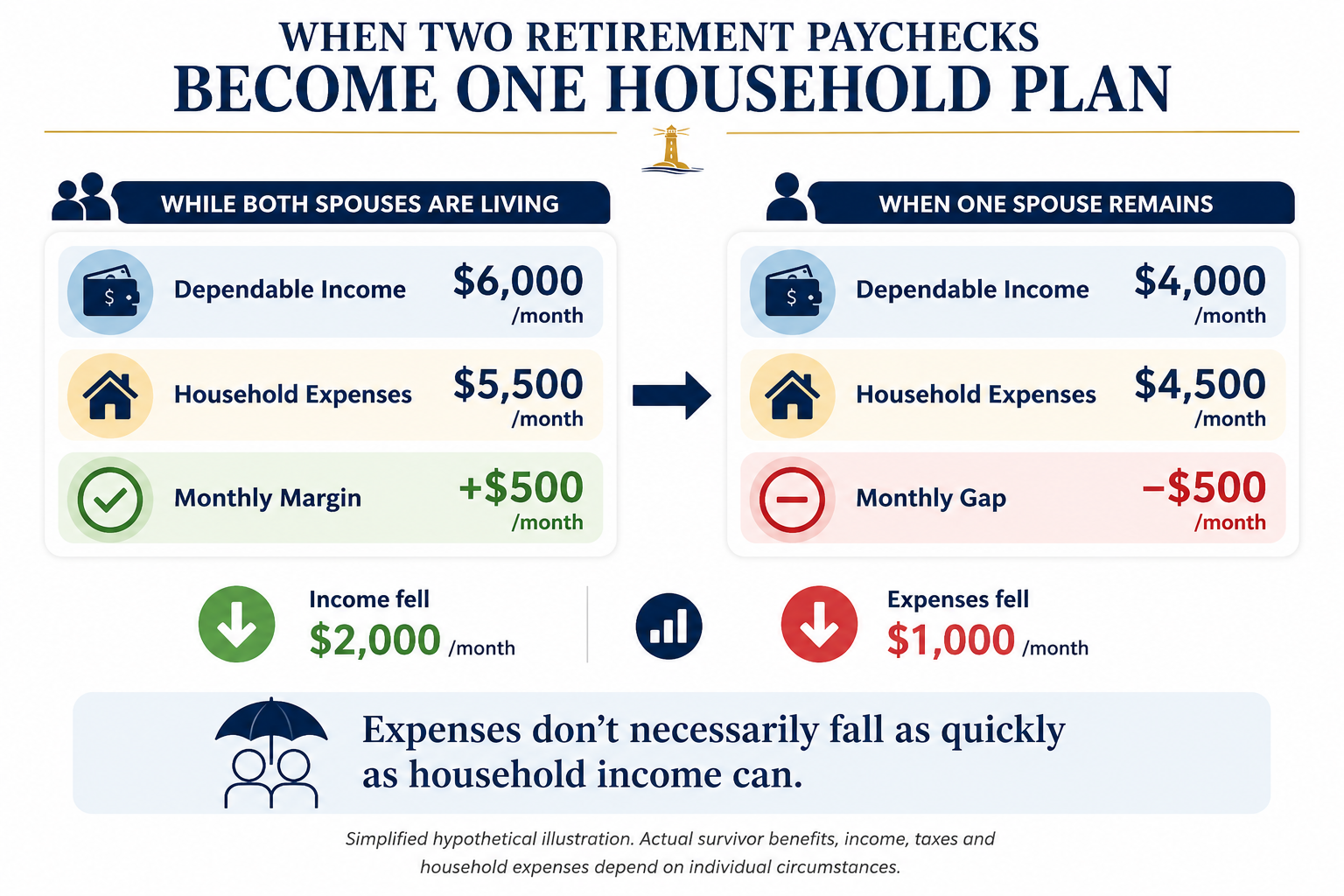
$6,000 per month
while both spouses are alive.
Now suppose that when one spouse remains, the household's dependable monthly income becomes:
$4,000
Again, this is only a simplified illustration—not a Social Security or pension calculation.
Their income has fallen by:
$2,000 per month
or about one-third.
Now imagine household expenses were previously:
$5,500 per month
and after the loss of a spouse they decline to:
$4,500 per month.
Expenses fell.
But not nearly as much as income.
The couple previously had:
$6,000 income − $5,500 expenses = $500 monthly margin
The surviving spouse now has:
$4,000 income − $4,500 expenses = $500 monthly shortfall
The household moved from a surplus to an income gap.
Not because spending increased.
Because income and expenses changed differently.
5. The surviving spouse may need the plan for many more years
The loss of a spouse doesn't necessarily occur near the end of the surviving spouse's retirement.
The surviving spouse could live many years—or even decades—after the loss of their spouse.
That means the survivor-income question isn't simply:
“Can the surviving spouse get through the next year?”
It may be:
“Can the surviving spouse maintain a sustainable income for the rest of his or her life?”
The retirement resources remaining at that point may need to provide income, liquidity and flexibility for many years.
Longevity therefore matters at both the household level and the individual level.
6. Taxes and healthcare can change too
The loss of a spouse can change more than household income.
The surviving spouse's tax situation may eventually change.
Healthcare expenses may change.
Insurance needs may change.
Housing decisions may change.
The mix of income sources may change.
Those issues can affect how much of the surviving spouse's income is actually available to spend.
This connects directly to the distinction we made in BR-08:
Gross retirement income and spendable retirement income aren't always the same.
A survivor-income review therefore shouldn't look only at how much income remains.
It should eventually consider what that remaining income may need to support.
Individual tax consequences should be evaluated with an appropriate tax professional.
7. Retirement assets may have different jobs after the loss of a spouse
While both spouses are alive, they may organize their retirement resources around the needs of the household.
When one spouse remains, those jobs can change.
Some savings may need to provide more income.
Some may need to remain liquid for unexpected expenses.
Some may still need an opportunity for future growth.
Some income sources may continue.
Others may change or disappear.
This reinforces a principle running throughout Blackburn's retirement education:
Not every retirement dollar needs the same job.
And those jobs don't necessarily remain unchanged throughout retirement.
8. The useful questions are surprisingly simple
You don't need to predict when one spouse will pass away.
You don't need to calculate every future expense.
And you don't need to know every future tax or Social Security rule.
But couples can still ask useful questions today:
- What dependable income do we expect while we're both alive?
- Which income sources could change when one spouse remains?
- Approximately what household expenses would remain?
- Which expenses might realistically decrease?
- Would the surviving spouse still have an income gap?
- What retirement resources could help address that gap?
- Would enough liquidity remain available?
- Could the surviving spouse maintain the lifestyle we consider important?
Those questions won't predict the future.
They help make sure one person's future isn't accidentally left out of a plan designed for two.
Bringing It Together
A retirement-income plan for a married couple shouldn't consider only the years both spouses are together.
Eventually, one person may need that plan to work alone.
Some household income may change or disappear.
Many household expenses may remain.
And the surviving spouse could still have years—or decades—of retirement ahead.
The goal isn't to predict exactly what that future will look like.
It's to ask one important question before it becomes urgent:
“If our household retirement income changes, will the person who remains still have the income and resources needed to live the retirement we've planned for?”
A retirement plan built for two should also consider the future of one.
Continue Your Retirement Income Education
Explore related lessons to keep building your retirement-income picture.
How Social Security Fits Into Your Retirement Paycheck
Understand how Social Security can form part of the dependable-income foundation for a household.
Read the lesson →Your Retirement Income and Your Spendable Income Aren't Always the Same
See why the amount coming into the household and the amount available to support your lifestyle can be different.
Read the lesson →What Determines How Long Retirement Savings Last?
Explore the forces that determine how hard retirement savings may need to work over time.
Read the lesson →See Your Retirement Income Picture
Your retirement isn't just an account balance. See how your income, savings and retirement priorities fit together.